gaplike
Inference on gapped and windowed stationary Gaussian data.
gaplike does joint signal + noise-parameter estimation when a stationary
time series is interrupted by data gaps, or multiplied by any window. It
provides gap-pattern generation for arbitrary patterns, windowed
frequency-domain covariances, and a hierarchy of likelihoods running from the
cheap Whittle approximation up to the exact time-domain likelihood —
evaluated either in closed form, when the noise is linear in two component
powers, or matrix-free at any scale by preconditioned conjugate gradients.
Only numpy and scipy are required. The two-component LISA TDI-2 A/E noise
model is built in; user-defined PSD components and any waveform work the same
way.
Companion package to “Zurückbleiben bitte: the impact of gaps on
noise and signal parameter inference” (O. Burke, F. Pozzoli & M. Muratore). The
paper/
directory reproduces every figure of that work.
pip install gaplike
Clone the repository instead if you also want the paper/ reproduction
pipeline or the notebooks — see Installation.
Why gaps are not a detail
Multiplying a time series by a gate is a multiplication in time, so it is a convolution in frequency. Every gap edge is a discontinuity, and each one throws power tens of bins away from where it belongs. On a spectrum as steep as LISA’s, that power lands where the true spectrum is orders of magnitude smaller — so a diagonal noise model, the Whittle likelihood, is no longer describing the data.
Two things follow, and gaplike is built to measure both.
Accuracy. The convolved diagonal, which corrects the modelled PSD for leakage, stays unbiased under quite severe gap patterns. Its point estimates are fine. It is the widths that go wrong.
Precision. A diagonal model must treat the aliased variance in every bin as independent noise, while the exact treatments exploit the strong bin-to-bin correlations of the gap pattern to unmix it. So the intervals a diagonal model quotes can be far wider than the data allow — by an order of magnitude under the drastic comb studied in the paper. The failure mode is inflation, not bias: not a confidently wrong answer, but a correct answer with error bars an order of magnitude too loose.
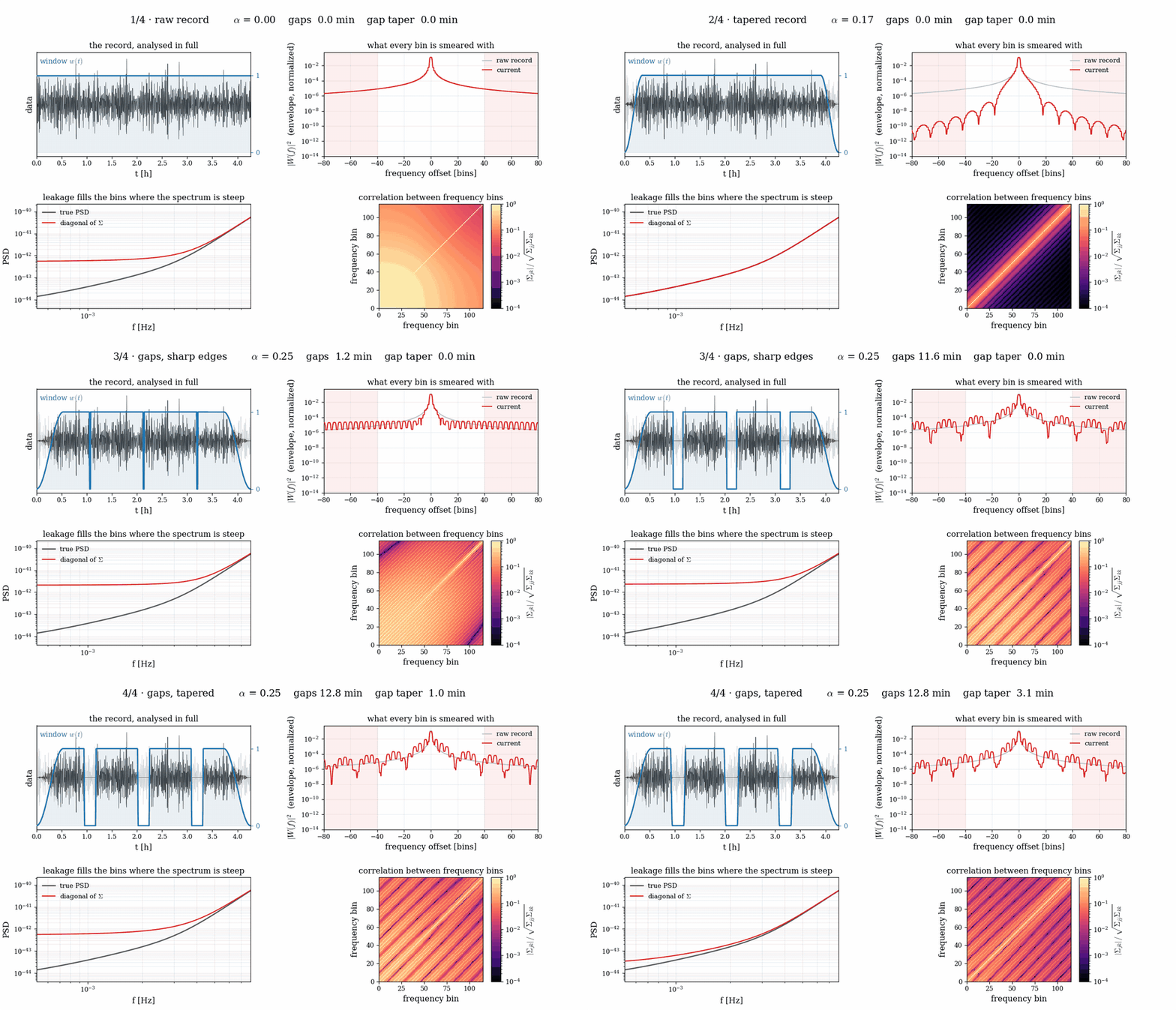
Four acts on the same record: a raw cut, then a taper on the record edges, then sharp-edged gaps, then tapered gap edges. Note that sharp gaps leak several times worse than the raw cut — six new discontinuities instead of two — and that tapering does not remove the correlations, it makes them local.
The remedy is one of the two exact treatments: the full windowed covariance in the frequency domain, or the time-domain likelihood of the observed samples, in which the missing samples are simply marginalized and no window appears anywhere. The likelihood hierarchy lays out when each one is the right choice.
Guide
Reference
Citing
Please cite the software (see CITATION.cff) together with Burke, Pozzoli & Muratore
(2026), Zurückbleiben bitte: the impact of gaps on noise and
signal parameter inference.